


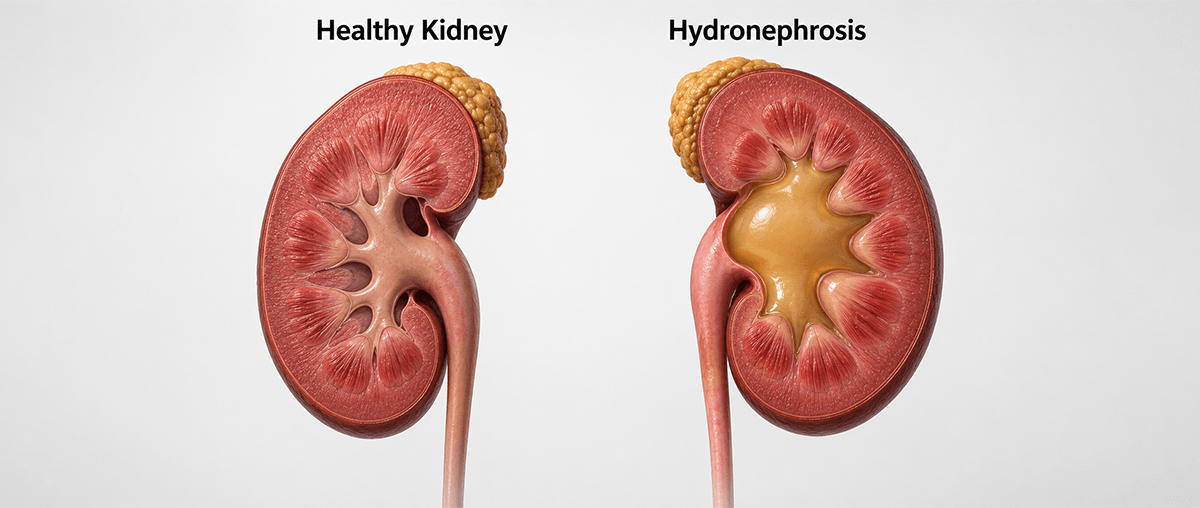

Kidney Hydronephrosis: Causes, Symptoms, Diagnosis & Treatment
Written by PeerlessOne on 22-07-2026
Medically Reviewed by Dr. Soumen Khamrui (DrNB - Nephrology)
Last Update on 22-07-2026
Table of Content
- Introduction
- What Is Kidney Hydronephrosis
2.1 How the Urinary Tract Works
2.2 Unilateral vs Bilateral Hydronephrosis - What's the Difference
2.3 Is Hydronephrosis a Disease or a Symptom
2.4 How Common Is It - Grades and Severity - Mild, Moderate, Severe
3.1 Grade 1 (Mild) Hydronephrosis
3.2 Grade 2-3 (Moderate) Hydronephrosis
3.3 Grade 4 (Severe) Hydronephrosis
3.4 SFU Grading System
3.5 Key Warning: Severity ≠ Pain Level - Causes of Kidney Hydronephrosis
4.1 Obstruction Causes
4.2 Functional Causes
4.3 External Compression Causes
4.4 Congenital or Pediatric Causes
4.5 Infection-Related Causes
4.6 Quick Reference: Common Causes and Affected Groups - Symptoms of Kidney Hydronephrosis
5.1 Common Symptoms
5.2 Asymptomatic Hydronephrosis
5.3 Emergency Red-Flag Symptoms
5.4 Symptoms in Infants and Children
5.5 Symptoms During Pregnancy - Diagnosis - How Kidney Hydronephrosis Is Detected
6.1 Ultrasound
6.2 CT Scan
6.3 MRI / MR Urography
6.4 Nuclear Medicine Scan (MAG3 / DTPA)
6.5 Voiding Cystourethrogram (VCUG)
6.6 Blood Tests
6.7 Urine Tests
6.8 Parental Diagnosis - Treatment Options for Kidney Hydronephrosis
7.1 Watchful Waiting and Observation
7.2 Medications Remedy
7.3 Minimally Invasive Procedures
7.4 Surgical Treatment
7.5 Emergency Drainage
7.6 Treatment During Pregnancy
7.7 Paediatric Cure - Special populations - Children, Pregnancy, Elderly
8.1 Hydronephrosis in Newborns and Children
8.2 Hydronephrosis in Pregnancy
8.3 Hydronephrosis in Men Over 50 - Complications If Left Untreated
9.1.1 UTIs and Pyelonephritis
9.1.2 Kidney Scarring and Reduced Kidney Functionality
9.1.3 Chronic Kidney Disease (CKD)
9.1.4 Sepsis
9.1.5 Kidney Failure - Outlook, Prevention & Living With Hydronephrosis
10.1 Prognosis
10.2 Follow-Up Care
10.3 Does Hydronephrosis Come Back
10.4 Preventive Measures
10.5 Healthy Lifestyle
10.6 Seeking Medical Help - Conclusion
- FAQs
Introduction
Kidney disease hydronephrosis is a disorder wherein one or both kidneys swell due to the accumulation of urine. This is similar to obstructing a drain; when there is any sort of hindrance in urine drainage, a build-up of fluid inside the kidney results in swelling. Though the condition may seem rather serious, hydronephrosis can be easily treated if detected in time. It can occur among individuals of all age groups, even in those who have not yet been born.
This guide is a kind of resource that can be really helpful for you to know all these core components of hydronephrosis:
- Defining what hydronephrosis is and how it occurs
- Identifying common causes and risks
- Possible signs and symptoms
- Diagnosing the condition
- Finding possible treatments
- Understanding when hydronephrosis can turn into a medical emergency
It’s reassuring to know that, when it comes to treating hydronephrosis, most people respond positively. This means early detection will prevent complications and lead to full recovery.
What Is Kidney Hydronephrosis
Kidney hydronephrosis happens when urine builds up and makes the kidneys swell because drainage is blocked. It ranges from mild hydronephrosis, which has few symptoms, to severe cases that could hurt kidney function if not treated.
How the Urinary Tract Works
The urinary system handles removing waste and excess fluid from the body via what seems like a pretty straightforward route:
Kidney → Ureter → Bladder → Urethra
- Kidneys: Filter metabolic leftovers and make urine.
- Ureters: Move urine from the kidneys over to the bladder, steadily and continuously.
- Bladder: Keeps urine stored until it’s time for it to be released.
- Urethra: Provides the exit route so urine can leave the body.
Unilateral vs Bilateral Hydronephrosis - What's the Difference
Hydronephrosis can hit one or both kidneys, based on where the blockage is. Knowing which matters for checking how much it affects kidney function and deciding how urgent the treatment needs to be:
| Feature | Unilateral Hydronephrosis | Bilateral Hydronephrosis |
| Kidneys Affected | One kidney | Both kidneys |
| Intensity | Often, it's less serious if the unaffected kidney is doing fine and the kidney functions stay normal. | Usually, it is more concerning since both kidneys are involved, not just one. |
| Impact on Kidney Function | It may have a limited effect on total kidney function, so overall outcomes can still be ok. | There is a greater risk of impaired kidney function if it goes untreated, and that can matter a lot later. |
| Common Causes | Kidney stones, a localised blockage, and PUJ obstruction can also show up. | Bladder outlet obstruction, an enlarged prostate, and some congenital abnormalities can contribute to this situation, too. |
Note: This detail matters because if both kidneys are impacted, doctors often rush to fix it to avoid hurting them both.
Is Hydronephrosis a Disease or a Symptom
Hydronephrosis isn't actually a disease; it's more of a sign that urine isn't draining properly. The usual hydronephrosis causes are kidney stones, birth defects, an enlarged prostate, tumours, and pressure from pregnancy. To treat it right, you really need to figure out what's causing it.
How Common Is It
Hydronephrosis is way more common than folks think. Around 1 in 100 adults will deal with it sometime in their lives. Plus, it turns up in about 1-5% of pregnancies. For unborn babies, it's the top urinary tract issue found in prenatal ultrasounds, so keeping a close watch and following up early is really key.
Grades and Severity - Mild, Moderate, Severe
Doctors categorise hydronephrosis by how swollen the kidneys are and any structural changes, too. Knowing the hydronephrosis grades 1, 2, 3, and 4 shows the seriousness, required treatment, and possible dangers.
Grade 1 (Mild) Hydronephrosis
At its earliest stage, hydronephrosis is mild.
- Key Features
Grade 1 is early-stage and often shows little damage, so patients might just need regular check-ups:
- Distention of the ureteric pelvis is mild.
- Parenchyma in both kidneys is functioning normally.
- This is generally an incidental finding in diagnostic tests.
- Asymptomatic patients comprise the majority of individuals.
The condition will usually improve on its own, depending on the reason for and the extent of the urinary blockage.
Grade 2-3 (Moderate) Hydronephrosis
Kidney swelling gets noticeable at a more advanced stage.
- Key Features
At this stage, symptoms and kidney swelling get more noticeable, making timely medical evaluations way more crucial:
- Swelling noted in the kidney.
- There will be an increase in size of the urine collecting system.
- You may experience flank pain or urinary problems.
- Evaluation and medical treatment may be required.
For moderate cases, not getting treated can seriously mess up kidney function, so don't ignore it.
Grade 4 (Severe) Hydronephrosis
The most serious stage causes big changes in the kidneys.
- Key Features
Severe hydronephrosis can really hit kidney health hard and needs quick treatment to avoid more damage:
- Severely enlarged kidneys.
- Marked decrease in the amount of kidney tissue (cortical thinning).
- Increased likelihood that renal function will be permanently damaged.
- Immediate intervention may be needed.
Appropriate care of those with severe hydronephrosis is essential for maintaining renal function.
SFU Grading System
The Society for Fetal Urology (SFU) grading system goes from Grade 1 to Grade 4, based on ultrasound results. It's commonly used to track hydronephrosis in newborns and see how things change over time.
Key Warning: Severity ≠ Pain Level
In kidney disease hydronephrosis, the seriousness of swelling doesn't always line up with pain levels. People might have it really bad yet feel little pain, so regular checks are super important.
Causes of Kidney Hydronephrosis
Hydronephrosis occurs when there is an obstruction preventing urine from flowing from the kidneys into the bladder. There may be several reasons behind this problem, but whatever it may be, it is vital to know how to treat it effectively.
Obstruction Causes
Physical blockages are pretty much one of the most common reasons people mention when they talk about kidney swelling causes:
- Kidney Stones are one of the leading causes in adults. The stones can block the ureter, and then urine can’t flow the way it should; it sort of just gets stuck.
- PUJ obstruction is also common; that’s a narrowing where the kidney meets the ureter. It restricts urine drainage, and the pressure builds.
- A urethral stricture happens when scar tissue narrows the urethra. Then the urine flow gets obstructed, and things don’t clear out right.
- Posterior urethral valves are an abnormal condition mostly seen in boys. There’s extra tissue that blocks urine drainage from the bladder, and it can start early.
These conditions increase urinary tract pressure, causing kidney swelling.
Functional Causes
At times, the urine flow gets impaired even when there is no clear physical blockage or anything like that:
- Vesicoureteral reflux, in other words, urine goes the wrong way; it backs up from the bladder into the ureters and all the way to the kidneys, instead of just leaving the body.
- Neurogenic bladder, basically nerve-related problems, can disturb how the bladder empties, so urine stays put, and the pressure rises, and that pressure can then stress the kidneys more than they should.
Functional disorders can, bit by bit, harm the urinary tract over time if it is not handled properly.
External Compression Causes
The problem could also be related to something else that happens outside the urinary tract, which presses it somehow from the outside in and thus disrupts urine drainage:
- Enlarged prostate BPH is pretty common in older men, and it can obstruct bladder emptying, like blocking the exit a bit.
- Especially in the third trimester of pregnancy, the growing uterus can squeeze the ureters, and that can help lead to hydronephrosis during pregnancy.
- Pelvic tumours can apply pressure on nearby urinary structures, and that becomes a problem.
- In rare situations, blood clots may block the urine drainage pathways, even though it’s not usual.
External pressure squashing the urinary tract can also disorganise the normal flow.
Congenital or Pediatric Causes
Some children are born with odd abnormalities that mess with urine flow, like how it moves along:
- PUJ obstruction is one of the more common congenital causes, basically at the level where the renal pelvis transitions into the ureter, which can get blocked.
- A child can be born with a duplicated ureter (two ureters) draining into one kidney, sort of like a split duct system, though the kidney is still one.
- VUJ obstruction narrows at the spot where the ureter joins the bladder, so urine drainage slows down, and that can lead to backup.
A lot of these problems are picked up during prenatal checks or later childhood imaging studies, like ultrasound, CT, or other scans.
Infection-Related Causes
Urinary tract infections can, now and then, lead to hydronephrosis or at least make it worse:
- Inflammation and swelling can show up, especially in severe cases, where the urine pathways may feel a bit tight or temporarily narrowed.
- Recurrent UTIs happen when infections keep returning; scarring may occur, and that kind of tissue change can interfere with the passage of urine over time.
Treating infections properly and on time reduces complication risks.
Quick Reference: Common Causes and Affected Groups
| Cause | Affected People |
| Kidney Stones | Adults |
| Enlarged Prostate (BPH) | Elderly Men |
| Pregnancy-Related Compression | Pregnant Women |
| Posterior Urethral Valves | Boys |
| Vesicoureteral Reflux (VUR) | Children |
| Neurogenic Bladder | Adults and Elderly People |
| PUJ Obstruction | Children and Young Adults |
| VUJ Obstruction | Children |
| Pelvic Tumours | Adults |
| Severe UTIs | All Age Groups |
Note: An accurate diagnosis is highly important for treating the problem and saving kidney function.
Symptoms of Kidney Hydronephrosis
Are you worried about hydronephrosis? Hydronephrosis comes with different urinary problems and other symptoms related to the kidneys, but some people remain unaffected. Symptoms may differ from those in adults. Symptoms of hydronephrosis vary depending on where the obstruction is located, how quickly it forms, and whether the obstruction affects one or both kidneys.
Hydronephrosis symptoms vary according to the level of obstruction severity, the cause of the obstruction, and the speed of its development. Some people have symptoms of discomfort, whereas others feel nothing. Generally, symptoms are progressive as the pressure increases in the kidney.
Common Symptoms
People often notice a few typical signs, such as:
- Pain in the side, flank, or lower back,
- A frequent urge to urinate,
- Trouble passing urine,
- Urine that looks cloudy, or sometimes blood-tinged,
- Fever, especially when there’s an infection happening,
- Nausea along with vomiting.
These hydronephrosis symptoms can pop up suddenly or build up over time, and they differ from person to person.
Asymptomatic Hydronephrosis
Some people don't get any symptoms and find out about hydronephrosis during routine tests:
- No clear pain or urinary troubles,
- Renal pelvic dilatation might show up even without symptoms,
- Kidney swelling can be there, even when discomfort is not noticed,
- Often it’s found incidentally on an ultrasound or a CT scan.
Regular check-ups and follow-up imaging could be key to catching it early and keeping track of it.
Emergency Red-Flag Symptoms
Get immediate medical help right away if any of these show up, without waiting:
- High fever with shivers,
- Intense, or worsening pain in the flank,
- Inability to void urine,
- Continuous vomiting with symptoms of dehydration.
All these symptoms may suggest a serious infection, a dangerous blockage, or other problems, which need immediate attention and evaluation.
Symptoms in Infants and Children
Symptoms vary from those experienced by adults:
- Abdominal mass or distention,
- Irritability without any known reason,
- Persistent UTI,
- Unknown fever.
Many cases of hydronephrosis in newborn babies are diagnosed before or after birth using imaging tests.
Symptoms During Pregnancy
In hydronephrosis in pregnancy, there is always a feeling of increased pressure in the urinary tract, especially later in the pregnancy:
- Right-sided flank pain,
- Lateral and posterior pain,
- Frequent urination,
- Some individuals suffer from nausea.
Kidney disease hydronephrosis can get worse, too, making symptoms persist. So, if pregnant women notice these issues, seeing a doctor is wise.
Diagnosis - How Kidney Hydronephrosis Is Detected
Accurate diagnosis of hydronephrosis is crucial in determining the correct course of action to take. Diagnosis of hydronephrosis can be done using various techniques, including imaging, blood tests, and urinalysis. Antenatal hydronephrosis can even be detected in fetuses through ultrasounds. Hydronephrosis, actually, is the most commonly occurring fetal urinary anomaly.
The following are some diagnostic tests that can help in diagnosing kidney disease hydronephrosis in adults, children, and even fetuses (antenatal or fetal hydronephrosis):
Ultrasound
Ultrasound is the first test that is usually done; it picks up on kidney swelling and is safe for kids and pregnant women since it's radiation-free.
CT Scan
The CT scan, however, gives clearer pictures and is great for spotting kidney stones, tumours, and blockages. Still, it’s usually skipped during pregnancy due to radiation.
MRI / MR Urography
When more information is needed about a pregnancy, an MRI is often used instead. It takes over after an ultrasound.
Nuclear Medicine Scan (MAG3 / DTPA)
Then there's the renal nuclear medicine scan, which checks how well the kidneys work and drain urine.
Voiding Cystourethrogram (VCUG)
It's commonly used on kids when vesicoureteral reflux is suspected.
Blood Tests
Besides that, tests like those for creatinine and blood urea nitrogen check how well your kidneys are functioning.
Urine Tests
Finally, urinalysis and urine cultures look out for signs of infection or other issues, like if there's blood in the urine.
Parental Diagnosis
Doctors frequently spot issues before the baby is born during the usual 18 to 22 weeks of scans. Finding problems early lets doctors keep a close eye on things and act quickly if there are any issues.
| Test | Showcase | Use Case | Radiation |
| Ultrasound | Kidney swelling and urine buildup | First-line evaluation, pregnancy, and children | No |
| CT Scan | Stones, tumours, and detailed anatomy | Adults with suspected obstruction | Yes |
| MRI / MR Urography | Soft tissues and urinary tract anatomy | Pregnancy or complex cases | No |
| Nuclear Medicine Scan (MAG3 / DTPA) | Kidney function and drainage | Functional evaluation | Low |
| Voiding Cystourethrogram (VCUG) | Backward urine flow (VUR) | Children with suspected reflux | Yes |
| Blood Tests | Kidney function markers (creatinine, BUN) | Assessing kidney performance | No |
| Urine Tests | Infection, blood, and urinary abnormalities | Investigating symptoms and infection | No |
Note: These tests, when taken together, enable medical practitioners to diagnose and treat hydronephrosis, identify what causes hydronephrosis, and determine the appropriate mode of treatment.
Treatment Options for Kidney Hydronephrosis
The goal of kidney hydronephrosis treatment is the restoration of normal urine flow and the reduction of any stress on the kidneys.
Watchful Waiting and Observation
When kidney function is stable and symptoms are mild, close watching might be enough.
- Typical Examples
- Mild hydronephrosis.
- Occur to unborn and newborn babies.
- People usually don’t have any major symptoms or problems.
Doctors could suggest checking with regular imaging instead of fixing right away, especially for babies and folks with milder issues. Plus, many times the problem gets better on its own without any major treatment.
Medications Remedy
Medicines mainly manage symptoms, infections, and underlying issues.
- Frequently Used Medicines
- For UTIs, doctors use antibiotics.
- Alpha-blockers help with an enlarged prostate or passing stones.
- There are also medicines for pain relief.
Medicines can't always get rid of a blockage. They can help with symptoms, infections and complications. This helps until a doctor plans treatment.
Minimally Invasive Procedures
These procedures help restore urine flow without major surgery.
- Choices to Consider
- Ureteral stent placement is one option.
- Percutaneous nephrostomy, also known as PCN.
- Ureteroscopy with stone removal.
They help restore urine flow without big surgery. A ureteral stent opens up the urinary tract, and a nephrostomy tube drains urine straight from the kidney for urgent decompression.
Surgical Treatment
Surgery is suggested for persistent blockages or structural problems.
- Common Surgical Procedures
- Pyeloplasty for PUJ obstruction.
- TURP for prostate (BPH).
- Tumour removal.
- Ureteral reimplantation.
When you have abnormalities, surgery might be your best bet for a long-term fix. Pyeloplasty surgery is the choice for treating PUJ obstruction, and it really works well in getting your kidney to drain properly.
Emergency Drainage
Drainage needs to be immediate at times to ease pressure and avoid kidney damage.
- Emergency Measures
- Urethral catheterisation.
- Suprapubic catheter placement.
If severe blockage leads to serious pain, infections, or messed-up kidney function, quick action for drainage is needed. Typically, catheterisation comes first to swiftly ease urinary tract pressure.
Treatment During Pregnancy
Keeping both mother and baby safe guides the care, which also ensures proper kidney drainage.
- Management Techniques
- Strict observation.
- Pain control.
- Short-term ureteral stenting.
- PCN as needed.
Most pregnancies are handled conservatively since the condition usually gets better after childbirth. Severe symptoms or kidney issues might call for temporary draining procedures.
Paediatric Cure
The doctors look at kidney function, drainage issues, and the kid's total growth to pick the best treatment.
- Treatment Alternatives
- Regular ultrasound assessment.
- Prophylactic antibiotics to prevent recurrent infections.
- Surgical correction to repair a significant drainage obstruction.
Without surgery, many kids get better as they grow up. But if kidney drainage stays bad or function is at risk, doctors suggest operating to avoid future problems.
Getting an early diagnosis and the right hydronephrosis treatments can save kidney function and lower the chances of lasting problems.
Special populations - Children, Pregnancy, Elderly
Hydronephrosis can hit anyone, but how it's caused, found, and treated varies with age.
Hydronephrosis in Newborns and Children
Prenatal ultrasounds often spot childhood cases during routine checkups. Common reasons are PUJ and VUJ blockages, vesicoureteral reflux, and, in boys, posterior urethral valves.
- General Features
- Issues like this are identified through the use of prenatal screening tests.
- Continuing ultrasound tests are usually done on a routine basis to track the issues.
- As the disease continues, the functioning of the kidneys will be measured using imaging studies (ultrasound).
- If there is a continuing blockage or a decline in kidney function, surgery may be needed.
Parents often wonder, ‘Can hydronephrosis go away on its own?’ For mild cases found before or right after birth, it might improve as the urinary tract develops. Still, consistent check-ups are crucial.
Hydronephrosis in Pregnancy
During pregnancy, hydronephrosis happens fairly often because the growing uterus can squeeze the urinary tract. It hits the right side more than the left due to how the uterus and nearby parts are arranged.
- Important Points
- The kidneys can get a little mixed up when a woman is pregnant. This is pretty common.
- It seems to happen to the kidney more often.
- Most of the time, things get better after the baby is born.
- When a woman is pregnant, there are not many ways to treat kidney problems as there are at other times.
If you get really bad symptoms or a fever, or if your kidney function seems off, seeing a doctor is crucial.
Hydronephrosis in Men Over 50
In older men, benign prostatic hyperplasia (BPH) leads to urinary blockages pretty often. The prostate grows bigger and messes up bladder emptying, adding pressure on the whole urinary system.
- Common Factors
- A big prostate is a risk factor.
- Symptoms often mix up with BPH symptoms.
- You might pee a lot. Have a weak pee flow.
- Often, doctors tackle both conditions simultaneously.
This can cause kidney disease hydronephrosis, which slowly develops over time. That’s why checking the prostate regularly and addressing urinary issues quickly are key to keeping kidneys healthy for the long haul.
| Group | Common Causes | Standard Diagnosis | Need for Surgery |
| Newborns and Children | PUJ obstruction, VUJ obstruction or VUR, posterior urethral valves, etc. | Ultrasound examination of the kidneys, assessment of kidney function, and measures to prevent urinary tract infection. | Only if there is impaired drainage or if kidney function is deteriorating. |
| Pregnant Women | Uterine compression on the ureters and psychosocial alterations in urinary tract physiology. | Observation, hydration, management of symptoms, and sometimes placement of nephrostomy tubes. | Very few times. |
| Men Over 50 | Prostate enlargement or hyperplasia (BPH) and obstruction of urine outflow. | Medications to manage prostate enlargement and monitoring of kidney function. | Hydronephrosis treatment sometimes depends on the extent of blockage. |
Complications If Left Untreated
When hydronephrosis is left unnoticed or unmanaged, the accumulation of urine may cause significant complications relating to the kidneys or the urinary tract, among which are infections. Studies reveal that if the problem remains untreated, infections in the urinary tract may affect the kidneys as well.
i) UTIs and Pyelonephritis: Spreading of infection from the urinary tract to the kidneys may result in harmful kidney infection and further inflammatory processes.
ii) Kidney Scarring and Reduced Kidney Functionality: Chronic pressure on the tissues may damage the kidneys and cause scars, hence reducing kidney performance.
iii) Chronic Kidney Disease (CKD): Blockage of the kidneys for prolonged periods may negatively affect their functioning, thereby worsening CKD.
iv) Sepsis: Infections entering the bloodstream may develop into sepsis, a very critical condition requiring immediate medical assistance.
v) Kidney Failure: Severe cases may affect kidney functionality severely; dialysis and even transplantation may be required.
Fortunately, such issues rarely happen when kidney disease hydronephrosis is caught and handled early on.
Outlook, Prevention & Living With Hydronephrosis
With timely diagnosis and management, hydronephrosis could stay harmless and be asymptomatic in most cases.
Prognosis
Once the underlying cause is addressed, recovery becomes possible, and it will be more likely to happen in time if the treatment begins prior to organ damage. It should be noted that in most cases, early treatment leads to better outcomes.
Follow-Up Care
Further monitoring may include repeat ultrasounds, kidney function testing, creatinine measurements, and monitoring the glomerular filtration rate (GFR). Such measures will help ensure normal renal drainage and recovery.
Does Hydronephrosis Come Back
The likelihood of recurrent attacks will depend on the underlying cause. Risk factors for recurrences include stone formation, repeated urinary tract infections, an enlarged prostate gland, or any kind of congenital anomalies. For people who are at a high risk, follow-up care is necessary.
Preventive Measures
Adequate hydration, prompt treatment of UTI, active prevention of kidney stones, and routine screenings of the prostate gland (after 50 years old) might prevent this issue. Proper urinary practices will help to maintain good health.
Healthy Lifestyle
Adequate fluid intake, proper nutrition, and avoiding high salt intake will be beneficial for your kidneys. People with chronic kidney issues should follow the dietary guidelines provided by their doctors.
Seeking Medical Help
Consult your physician in case of recurrence of signs, including decreased output of urine, fever, and pain in the vicinity of your kidneys. Prompt actions will avoid complications and preserve your kidney function.
Over 90% of properly handled cases have great long-term results too. People mostly keep their normal kidney function and everyday lives.
Conclusion
Hydronephrosis vs kidney disease can be important to know because hydronephrosis is not a disease; instead, it is caused by the inability to drain urine properly. The symptoms may be minor or severe; however, a quick diagnosis and treatment will help you. To avoid further problems and maintain your kidney health, you need to find the reason for your hydronephrosis; it may be kidney stones, pregnancy, malformation, or prostatic hypertrophy.
If you’re dealing with ongoing urinary symptoms or you’ve been told you have hydronephrosis, it’s really important to seek expert medical guidance; don’t just wait it out. The doctors at Peerless Hospitals in Kolkata provide a complete check-up, advanced diagnostic services and customised treatment plans, covering a broad list of kidney and urinary tract issues. With the clinical know-how and a patient-focused approach that Peerless hospitals are known for, people can also look into the other services and initiatives run by the Peerless Group. It’s a trusted name in multiple sectors, known for quality, dependable care and community-minded support.
FAQs
Is hydronephrosis the same as kidney disease?
No, it isn't. Hydronephrosis means your pee isn't draining right from your kidney, whereas kidney disease hits kidney function directly.
Can hydronephrosis heal on its own?
Yeah, some milder cases can, especially in kids and during pregnancy. Still, keep an eye on it with a doctor.
Is hydronephrosis risky?
It can be if you don't get it treated. Your kidneys might get hurt from a lasting blockage, though most times, early treatment works well.
So, what's mild hydronephrosis?
It just means your kidney's a bit swollen, but it doesn't affect how well your kidney functions yet.
Can hydronephrosis cause kidney failure?
If left untreated, severe cases can result in permanent kidney damage, and in rare instances, they can lead to kidney failure.
Is hydronephrosis painful?
Some folks get flank or back pain, but others feel nothing until it shows up on an imaging test.
How long does it take to treat hydronephrosis?
Well, that depends. You could be looking at a few weeks or several months based on what's causing it and how bad it is.
Can you prevent kidney hydronephrosis?
There's no guarantee, but staying hydrated and tackling urinary infections or kidney stones early might lower your risk.
You may also like

In India, the lack of adequate haemoglobin in blood, especially among women and children are so severe that public health experts deem it to be a crisis
Read More
Fallopian tube blockage or tubal factor infertility is believed to be responsible for anywhere between 25 and 35 per cent of female infertility cases in India.
Read More
Creatine Phosphokinase-Muscle Band or CPK-MB test is a pathological examination done by drawing blood from a patient’s vein suspected to have had myocardial infarction, commonly called a heart attack
Read More
The incidence of bulky uterus, with uterine fibroids being the leading cause, is a global concern.
Read More
Hyperuricemia or elevated uric acid strikes one in every five adults globally, and one in every four in India, and the level can be determined through a blood test.
Read More