



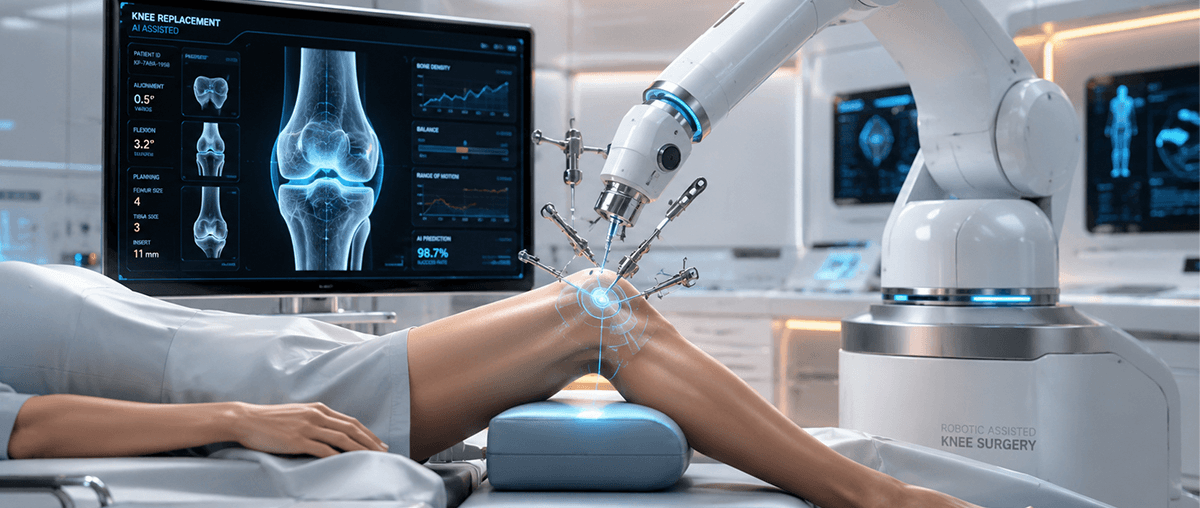

How AI and 3D Robotics are changing knee and hip replacement at Peerless
In a world driven by computers and AI, it is but natural that the technology would take over the operation theatres for improved outcomes. So much so that cases are being reported in which the surgeon is operating on a patient who is in a hospital hundreds of kilometres away. In the case of orthopaedic surgeries, though, the nature of the procedures requires the physical presence of a surgeon along with his team to carry it out with robotic help. According to a PubMed Central paper published in 2020, robotic surgery can improve the longevity of the implants in the case of knee replacements by over 50 per cent. In the last six years, the technology has leapfrogged and now helps obtain more efficient outcomes. At the Peerless Hospital, patients can now reap the benefits of the latest technology in this field
What is robotic surgery
Robotic-assisted orthopaedic surgery occurs when a machine assists the surgeon to improve his accuracy, or the result of the surgery. The main aim of any surgery is to restore the alignment of the bones, restore the soft-tissue balance, and, in certain cases, remove the damaged/diseased part with a replacement. Earlier procedures were performed manually with company-specific instrumentation (where different companies selling the implants would provide compatible cutting implements). For example, rods were inserted inside the femur bone, or outside the tibia bone or femur bone, following “Jigs” which are basically cutting guides, that helped in the actual cutting of the bone with a saw. The entire action was conducted according to the vision and expertise of the surgeon, depending upon the instruments being used. But now with the AI driven robots, the process has become more homogeneous and accurate.
Why robotic surgery
For the last two or three decades, the norm was about 90 degrees of knee movement. As with other diseases, the age threshold of arthritis has also come down. Whereas people used to get afflicted in their sixties and seventies, nowadays, they are getting affected in their fifties, requiring knee replacements. Naturally, the demand for the replacement of knees is also getting more pronounced as patients seek a more active lifestyle these days. If this was one of the reasons that has brought about the developments in the domain, the general advancement in medical science has also made a difference. If one were to add the improvements brought about by the increase in the body of experience of the surgeons performing such surgeries, one generation passing on their acquired skills to the next, one will begin to comprehend how we have reached this era of excellence.
In the past, when operations were completely manual, a 2–3-degree misalignment was acceptable. Then came the era of computer-assisted surgery, where a pre-operative plan was provided by the computer. From this has emerged robotic surgery of modern times. Here, I would like to specify that unlike robotic surgery in other fields of medical specialisation, like gynaecology, or oncology, for example, where the surgeon sits on his console in the ante-chamber with the robot performing the designated tasks on the OT, in orthopaedic surgery, it is different. Here, the surgeon is there with the patient, he has to open up the knee, clear all the soft tissues, with the robot only guiding the surgeon in the actual cutting of the bone. The surgeon, after completing all the work of clearing the soft tissue from the area, positions the robotic arm at a specific place on the bone. It then cuts the bone, or guides the surgeon with the cutting guides to physically cut the bone. So, it is more of a humanoid-robotic enterprise, robot-assisted, if you may.
Why is it more accurate
In terms of accuracy, with these procedures, the increase has been good – from 3 per cent to 0.5 per cent. We at Peerless use a humanoid robotics system from HoloLens or Artho3D, which is basically an AI augmented system that creates a complete 3D picture for the surgeon to act upon through a VR camera, even though only a four-inch area has been opened. This helps the surgeon to maintain the alignment and perform the cuts.
In the earlier processes, where holes were drilled into the bone for the insertion of rods, there were chances of pulmonary embolism, which often caused life-threatening issues. It also led to increased amounts of bleeding as the medullary canal was opened. Again, in cases where patients had undergone earlier surgeries in the hip or femur bone, traditional knee replacement surgeries could not be performed and would require a robotic, computer-assisted, or AI-augmented procedure.
Reduced pain implications post-surgery
Because of better alignment and higher accuracy, the patient suffers a lesser amount of pain. This pain is felt not during the surgery or its immediate aftermath, but during the post-operative physiotherapy. In India, the age at which patients approach a surgeon for knee replacement is far more advanced. Here, nothing below grade 4 is generally operated on, which leads to increased pain as many more procedures in terms of soft tissue release and ligament release are required. Besides, because of the advanced age of patients, the legs are already bent before the surgery is performed. And, in straightening the leg, the tissues get stretched on one side, which again causes some amount of pain. This leads to pain in the first four to six weeks after the operation.
Some earlier robotic procedures caused Iatrogenic injuries (unintentional damage to nerves, vessels, or tissues caused by medical intervention, such as surgery, positioning, or instrumentation). However, this has been corrected to a great extent. The cost factor, though, is a factor to take into consideration. The robotic surgery is certainly more expensive than manual surgery. But, given the greater accuracy, the associated costs usually go down in comparison.
Any surgeon who can conduct a traditional knee replacement can also perform a robotic surgery with some training. However, the converse is not true, as surgeons who start with a robotic knee replacement can seldom perform a traditional surgery. This ability to perform traditionally becomes critical in case the robot fails during surgery, requiring the surgeon to step in physically to complete the procedure.
It has been proven empirically that robotic surgery is better than manual surgery over a period of five years. However, longer-term implications are yet to be proven, though it is expected that over time, results of robotics will prevail.
How it is done at the Peerless Hospital
In Peerless, what we use is called the HoloLens humanoid robotics, which is AI-augmented reality. The advantage of this system is that it is compatible with the implants made available by all the supplier companies. This makes our system independent of any particular company in terms of sourcing the implants, and the surgeons can freely choose implants that they deem will best serve the requirements of the particular patient. HoloLens allows the performance of hip replacements, unicondylar knee replacement, which provides the hospital with a big advantage. This system is also cost-effective as it has a slight edge over traditional robotic surgery in terms of financial implications. Because the procedure requires the conducting of a CT scan, the patient is exposed to some amount of radiation, but that is well within the permissible levels.
How long does the surgery take
The time taken for the surgery is almost the same as traditional surgeries, with the robotic surgery requiring slightly more time, as some additional mapping must be done. More than a hundred procedures have been done in the last two years in Peerless, with a phenomenal success rate. Patients are made to walk on the very next day after the operation, and are mostly discharged within three to four days. Physiotherapy is recommended to be continued after discharge, which as was stated earlier, is the only painful part in the whole process.
In robotic surgery too, pre-operative planning is of utmost importance. And here HoloLens provides a definite edge as the details of the preoperative planning are spelt out in minute detail, facilitating the ordering of implants depending on the specifics of the case. But like all machines, the surgeon must be completely alert at all times and should intervene whenever it is deemed necessary.
You may also like

Best Home Remedy for Low Blood Pressure
Jun 4, 2026Have you ever stood up from a couch and felt a sudden dizzying tilt? If yes, then worry not
Read More

There is a quiet revolution transforming the healthcare infrastructure scene in the North-Eastern states of the country, with Guwahati as its epicentre and Peerless Hospitals playing a key role in the metamorphosis.
Read More
The incidence of cases requiring neurosurgical intervention is on the rise globally, and India is no exception.
Read More
Just having cancer is not enough to threaten mortality.
Read More
Paediatric surgery is different from general surgery primarily because paediatric surgeons have to deal with very small patients.
Read More