


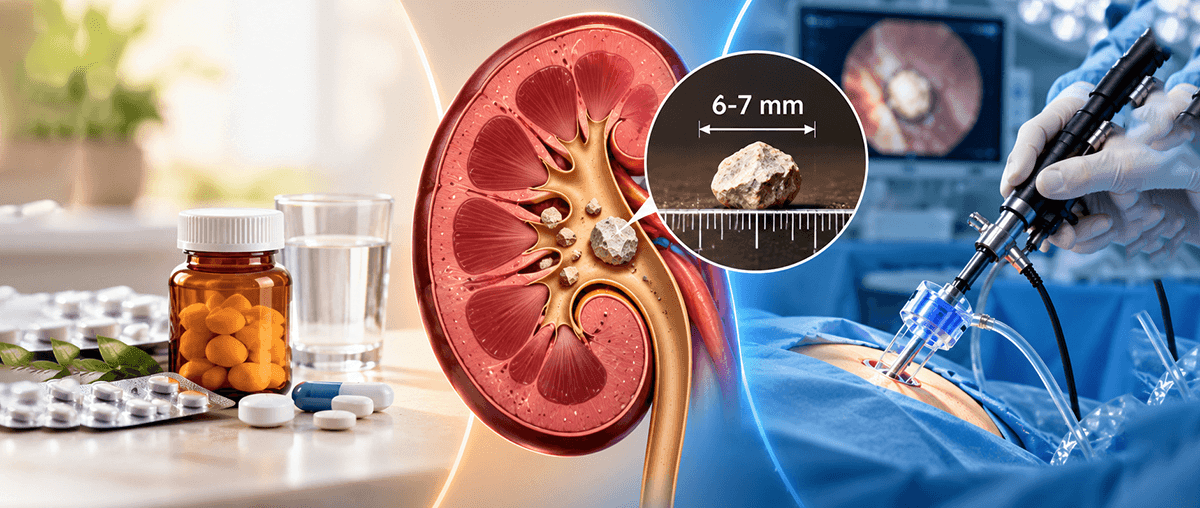

Kidney Stones 6-7mm: Medication or Surgery?
Written by PeerlessOne on 16-11-2026
Medically Reviewed by Dr. Avisek Dutta (MCh. - Urology and Renal Transplant)
Last Update on 27-07-2026
Table of Content
- Introduction
- 6mm and 7mm Kidney Stones: The Same?
- Comparison of 6mm and 7mm Kidney Stones' Chances of Passage
- Location of the Stone Is as Important as Its Size
- Symptoms of 6-7mm Kidney Stones
- Immediate Visit to the Doctor
- Diagnosis: How Doctors Confirm the Size and Location
- Medications vs. Surgery: How Do Doctors Make the Decision?
- Medical Management of 6-7mm Stones
9.1 Medical Expulsion Therapy - Surgical Treatments for 6-7mm Stones
10.1 ESWL - Shock Wave Lithotripsy
10.2 Ureteroscopy / RIRS
10.3 Mini-PCNL / PCNL - Cost Estimation for Treatment in India
- Recovery Period Following the Treatment
- What Happens If You Leave a 6-7mm Stone Untreated?
- Do Home Remedies or Diet Work on 6-7mm Stones?
- Prevention of Future Kidney Stones
- Key Takeaways: Kidney Stones of 6mm vs. Kidney Stones of 7mm
- FAQs
Introduction
Once there is a diagnosis of a kidney stone that is either 6mm or 7mm, the next most important thing is how one can expel it without requiring any intervention. Size notwithstanding, other factors to consider include location, pain experienced, obstruction, presence of an infection, and kidney functionality.
6mm and 7mm Kidney Stones: The Same?
- While 6mm and 7mm calculi are similar in terms of size, the probability of passage becomes lower as the stone size is increased. A one-millimetre difference might have an impact on the probability of passage, although the whole clinical scenario is important.
- A kidney stone can stay in the kidney or pass into the ureter. The position of the stone and the obstruction it creates will play a part in the decision of what to do next.
Comparison of 6mm and 7mm Kidney Stones' Chances of Passage
When it comes to kidney stones of 6mm and kidney stones of 7mm, there is no specific percentage chance of passage for all patients. Studies indicate that the higher the size, the lower the chance of passage. There is a better chance that stones in the lower ureter will pass compared to those found in the upper ureter.
| Size | Natural Passage | Typical Approach |
| Kidney Stones of 6mm | Yes, but not always | Medical management or observation therapy can be employed if the case is uncomplicated. |
| Kidney Stones of 7mm | Uncertain compared to 6mm | Urological evaluation is vital, and active intervention may be considered based on the case |
Location of the Stone Is as Important as Its Size
The kidney stones of 6mm in the lower ureter have a different prognosis compared to 6mm stones located close to the kidney:
- Kidney: There is a possibility that it can remain there symptomlessly and needs monitoring depending on its properties.
- Upper Ureter: There are less chances that it will pass as compared to stone in the lower region.
- Lower Ureter: The chances of stone passage increase as it is closer to the bladder.
Imaging is necessary because it validates the size and position of the stone and also helps determine if urine flow is obstructed. Initial imaging may be done using an ultrasound, although further details may be gained through a non-contrast CT scan.
Symptoms of 6-7mm Kidney Stones
Some common symptoms include:
- Severe pain in the flanks or back, which can sometimes extend to the groin area
- Presence of blood in the urine
- Nausea or vomiting
- Pain during urination
- Fever and shivering, especially when there is an infection
- These symptoms are not unique to kidney stones; therefore, clinical testing must be done for diagnosis.
- These symptoms can vary according to the position of the stone as well as its mobility.
Immediate Visit to the Doctor
Urgent medical care is required when kidney stone symptoms are present alongside:
- Fever or chills
- Vomiting that persists or cannot be controlled
- Severe pain that is difficult to manage
- Low or non-existent production of urine
- Single-functioning kidney
- Transplanted kidney
- Pregnancy
The presence of an obstructing stone in connection with infection or no formation of urine is a case that requires immediate drainage.
These warning signs should not be ignored.
Diagnosis: How Doctors Confirm the Size and Location
Doctors can conduct the following investigations:
- Ultrasound: Used as the primary imaging investigation that can locate the stones and urinary tract dilatation.
- CT KUB: The non-contrast CT scan is the gold standard for diagnosing the acute ureteric stones, since it offers details on size, localisation, and density.
- X-Ray KUB: May help to find the radiopaque stones.
- Urinalysis: Blood, signs of infection and other problems in the urine can be identified.
- Blood Tests: Assessment of kidney function, among others, can be done.
The combined results allow the urologist to decide whether a 6-7 mm stone is amenable to observation or requires treatment.
Medications vs. Surgery: How Do Doctors Make the Decision?
It is based on the entire clinical profile instead of just the test. The physician may evaluate:
- Stone size and location
- Pain intensity
- Ureteral or urinary tract obstruction or hydronephrosis
- Presence of infection
- Function of kidneys
- Composition and density of stones
- Anatomy of the patient
- Patient's response to conservative therapy
Thus, therapy needs to be personalised based on the stone’s properties and the patient’s clinical state.
Medical Management of 6-7mm Stones
In some uncomplicated ureteral stones, a period of observation with adequate pain control may be indicated especially if there is no sign of infection or obstruction.
Medical Expulsion Therapy
In selected distal ureteral stones measuring 5-10 mm, the use of an alpha-blocker can be taken into consideration by the doctor. This needs to be done depending on the patient's case.
Analgesics and hydration may be recommended by the treatment team as applicable.
- Critical Note: Dissolution of stone via medical means is normally impossible with the aid of any drug. This is because most kidney stones consist of calcium, which cannot be dissolved via drugs alone. However, some uric acid stones may be dealt with via urine alkalinisation.
Observation does not mean ignoring the stone. The patient under conservative management needs to be re-evaluated to check if the stone has passed or if the patient's condition requires active management.
Surgical Treatments for 6-7mm Stones
If the stone does not pass, causes obstruction or pain or leads to other complications, active treatment might be needed.
ESWL - Shock Wave Lithotripsy
The ESWL procedure breaks down the stone into tiny pieces through the use of focused shock waves. This procedure can be used for particular stones based on the size, density and position within the body.
Ureteroscopy / RIRS
The procedure involves inserting a thin device into the urinary system in order to access the stone. Laser lithotripsy can be used to break up the stone to remove the fragments.
Placement of a temporary JJ stent may be done to drain the urine effectively. The presence of a stent can result in frequent urination, bladder irritation, or flank pain, and the stent should be removed depending on the clinical scenario.
Mini-PCNL / PCNL
PCNL offers direct access to the kidney via a small cut in the skin. It is mostly used for bigger or complicated kidney stones, and it is not usually the standard procedure used for a simple 6-7 mm kidney stone. It all depends on the nature of the stone and the patient's individual circumstances.
| Procedure | Best Suited For | Anaesthesia | Hospital Stay | Recovery |
| ESWL | Accessible stones chosen | Anaesthesia/sedation varies | Generally short | Often several days |
| URS / RIRS | Ureteric or renal stones that need to be removed | Generally general/regional anaesthesia | Generally short | Several days to about 1-2 weeks |
| PCNL | Complex or large renal stones | General anaesthesia | Generally long | Several days to weeks |
Cost Estimation for Treatment in India
- The cost of treatment depends on the type of treatment, hospital, location, technology, anaesthesia, admission criteria, and after-care services.
- Since the ultimate treatment might be observation, medication, ESWL, ureteroscopy, or some other procedure depending on the individual case, it is important for patients to get the exact cost of the procedure performed at their hospital of treatment.
Recovery Period Following the Treatment
- The process of recovery depends upon the method of treatment as well as the condition of the patient. The period of recovery may be short in the cases of ureteroscopy and ESWL, but the process of recovery takes more time for PCNL.
What Happens If You Leave a 6-7mm Stone Untreated?
- If you do nothing about your stone, it may cause obstruction, hydronephrosis, recurrent urinary infection or impairment of renal function. An obstructing stone with infection needs immediate medical treatment.
- However, this does not imply that all 6-7 mm stones need surgery right away. There are some uncomplicated stones that can be monitored medically.
- If the stone keeps obstructing or causing symptoms, then the urologist will suggest an intervention based on its location, size, signs and symptoms, and other clinical manifestations, among others. Laser surgery for kidney stones is used to treat kidney stones through fragmentation and removal of those.
Do Home Remedies or Diet Work on 6-7mm Stones?
- Lemon water and adequate fluid intake might help in preventing the development of more stones in suitable patients; however, they must not be seen as a means for dissolving a 6-7 mm calcium stone.
- Dietary interventions are more significant for prevention purposes than for physically extracting a formed stone from the body. The correct changes to diet would be dictated by the kind of stone and the risk factors.
Prevention of Future Kidney Stones
After assessment of the current kidney stone, the following preventive efforts can be made depending on its composition and risk factors:
- Drink sufficient fluids except if restricted by your doctor.
- Limit high sodium consumption.
- Calcium should not be restricted from your diet unless otherwise directed by your physician.
- Limit high animal protein consumption if needed.
- Modify consumption of high-oxalate foods when calcium-oxalate stones are found.
- Add citrate-containing foods or beverages when necessary.
- A metabolic workup for recurrent stones might be required.
The preventive measures depend on the type of stone as well as the causative factors involved in its development.
Key Takeaways: Kidney Stones of 6mm vs. Kidney Stones of 7mm
Though kidney stones of 6mm may have a greater chance of passing than kidney stones of 7mm, both stones don’t always mean that surgery will be necessary. Follow-up and treatment will depend upon the evaluation of the urologist and the patient’s clinical status.
With our hospitals equipped with the right tools for diagnosis, including imaging studies, labs, and urological expertise, we can diagnose the exact size and location of the stone and determine what treatment should be administered.
Patients who often face problems with kidney stones can always get checked at Peerless Multispeciality Hospitals, where diagnosis and treatment can be done accordingly. Being a part of Peerless, our healthcare institutions try to provide suitable treatment and care.
For anyone experiencing chronic pain or who knows that they have a 6-7 mm kidney stone, a urological evaluation can help determine next steps.
FAQs
Can a 7mm kidney stone pass without surgery?
Passage of a 7mm kidney stone without surgical intervention is possible in some cases, but the passage is less predictable when compared to the passage of smaller stones. Other aspects also have to be looked into.
Is a 6mm kidney stone considered large?
Although a 6 mm kidney stone may not be one of the biggest kidney stones, its size can make spontaneous passage somewhat unpredictable. The probability of spontaneous passage can vary depending on the patient and also depending on the features of the stone and its location.
How painful is passing a 6-7mm kidney stone?
The pain associated with a stone passing through the ureter or obstructing urine flow can be severe. The intensity depends on how fast the stone is moving and how obstructed it is.
How long can I wait before treatment becomes necessary?
There is no standard waiting time for all patients. The time will depend on symptoms, presence of infection, blockage, functioning of the kidneys, position of the stone, and whether the stone is passing out.
Will the stone come back after treatment?
The recurrence of kidney stones is possible even after treatment if the risk factors remain uncontrolled. Adequate fluid intake, diet modification according to the type of stone, and follow-up can decrease the chances of recurrence of such stones.
Is PCNL required for a stone this small?
PCNL procedure is commonly used for larger kidney stones. It is not mandatory to go for PCNL for a 6-7mm stone; however, the choice of the procedure depends on the stone's position and nature.
You may also like
Chemoport has come in as a blessing for cancer patients.
Read More

Breast cancer screening is a vital procedure that plays an important role in diagnosing breast cancer even in cases where no symptoms are present.
Read More
Symptoms After An Injury may range from simple distress to a possible emergency.
Read More
Hairline fracture is the term used to describe a minor breakage of the bones due to repetitive strain.
Read More
Which Doctor to Consult for Headaches?
Oct 7, 2026The headache is one of the most frequently reported medical conditions by many individuals looking for professional help
Read More